You can usually feel a bent bottom track before you ever see it. The door drags or thumps over one spot, climbs slightly as it crosses a hump, then drops on the far side. Some people describe it as the panel "skipping" or feeling heavy only in the middle of its travel. Others notice the door rides up off level, the lock no longer lines up, or there is a new gap at one end letting in drafts and bugs. When the metal channel the wheels ride in gets flattened, crimped, or humped, the whole door telegraphs it.
The question almost every caller asks next is the right one: does a bent or busted track have to be torn out and replaced, or can it be fixed in place? The honest answer is that it depends on what kind of damage you have, and there are three repair paths worth understanding before anyone quotes you a full replacement.
How bottom tracks actually get damaged
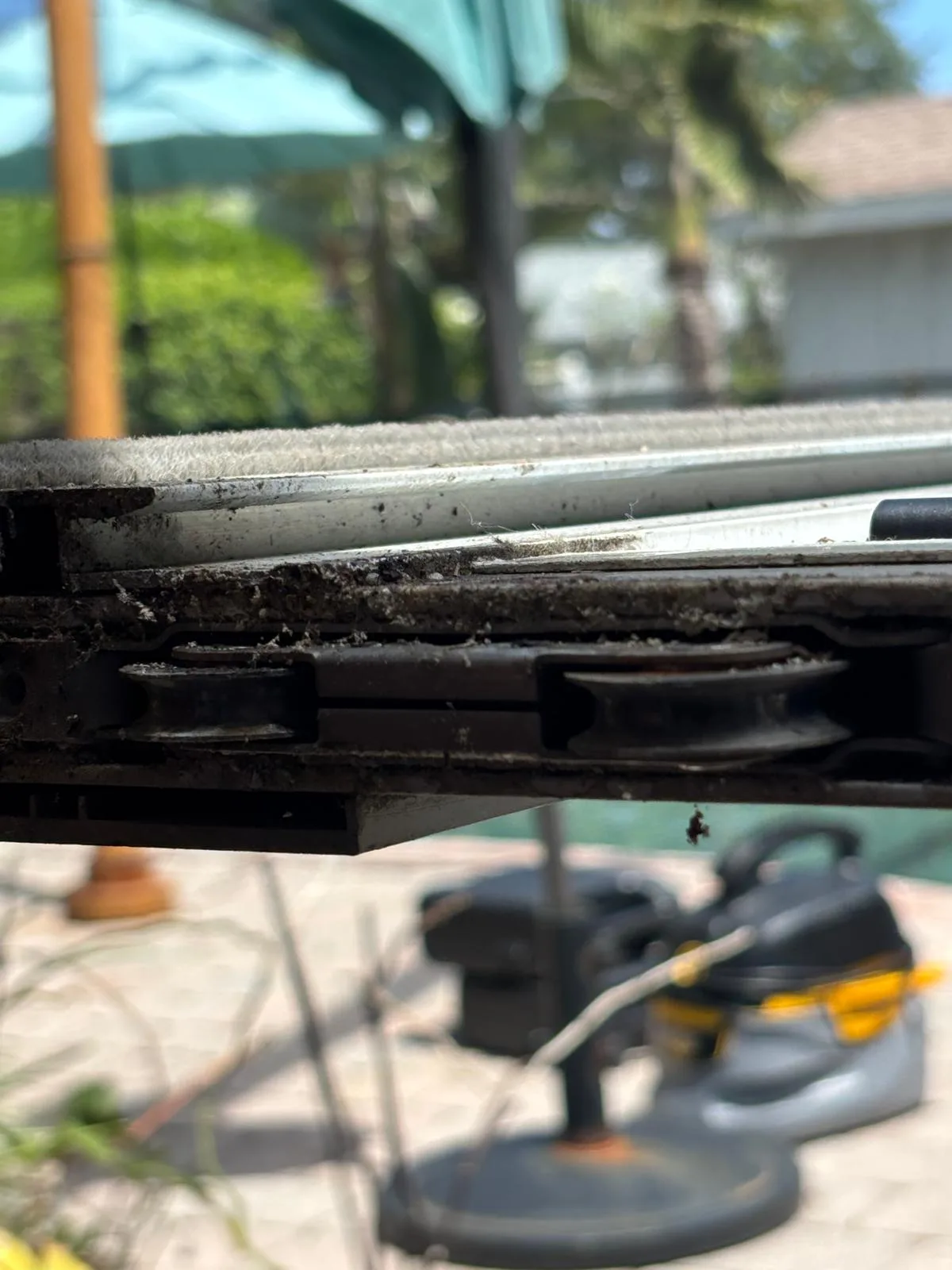
The bottom track takes the entire weight of the panel through two small wheels, so it wears and deforms in predictable ways. The most common culprit is rollers that failed months ago. Once a wheel seizes or flat-spots, the panel grinds metal-on-metal and the track lip rolls over, mushrooms, or flattens. Dropping a heavy impact panel during a hurricane prep, dragging furniture across the threshold, and plain corrosion in coastal salt air all do their share too. Older doors from the 70s, 80s, and 90s often used softer aluminum track that dents more easily than modern extrusions.
That history matters, because a track that is simply worn or lightly crimped is a different repair than a track that is structurally folded or pulling away from the slab.
Repair option 1: cleaning, straightening, and recapping
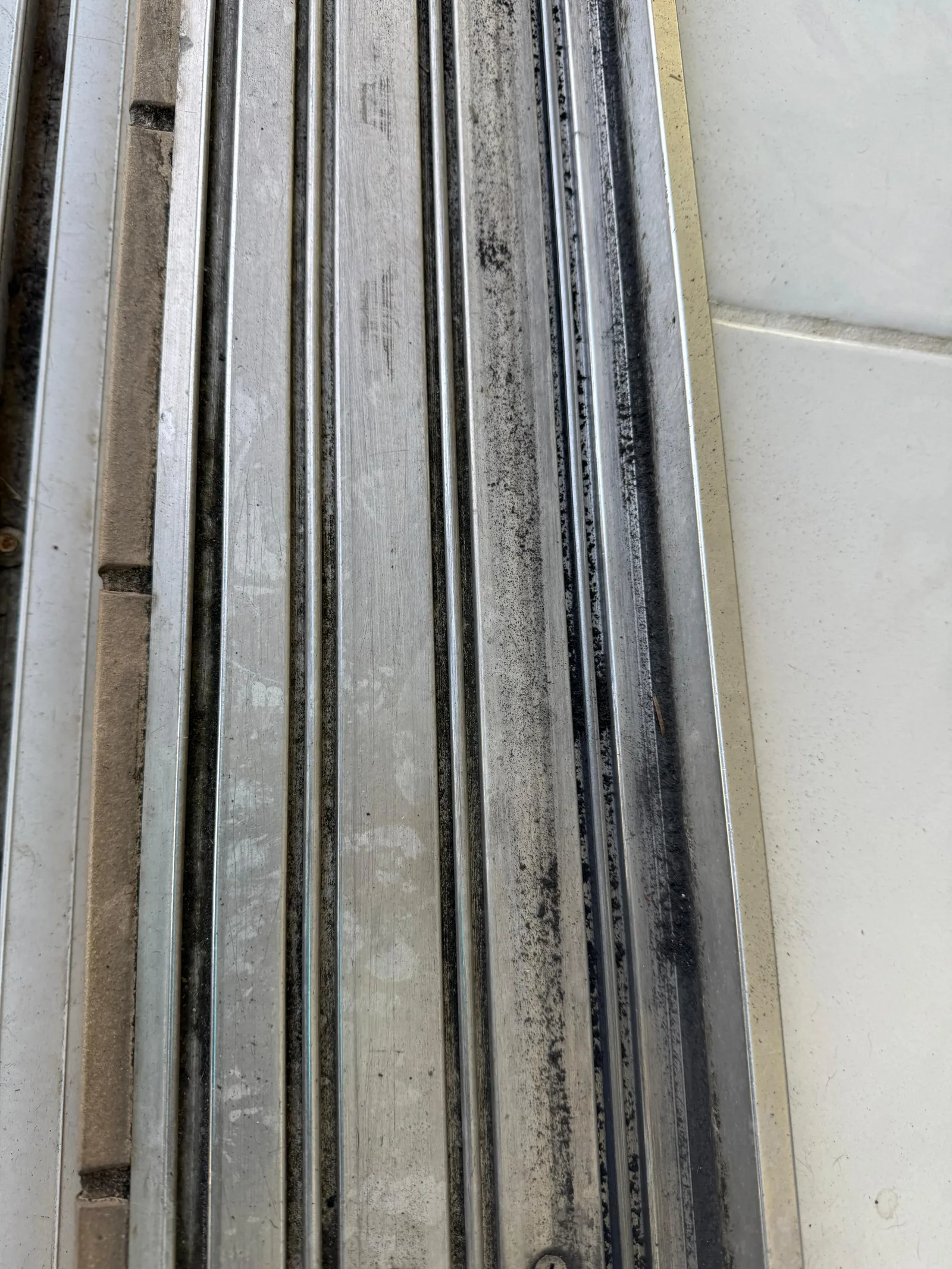
For light-to-moderate damage, the track does not have to come out. A technician cleans decades of grit out of the channel, straightens minor bends, and then installs a track cap. Recapping means fitting a new wear surface, often a stainless steel cap cover, right over the existing damaged track so the rollers ride on fresh, true metal instead of the chewed-up original. This is frequently paired with new rollers, because putting good wheels back on a bad surface just damages them again.
Track cleaning and capping typically runs in the $250 to $550 range for a standard 8-foot door, with larger 16-foot runs estimated around $400, depending on door and market. Track work is also often priced around $25 per linear foot when quoted on its own. Recapping is the value play: it restores smooth travel for a fraction of replacement cost and avoids disturbing the frame.
Stainless steel vs aluminum caps: stainless cap covers resist corrosion and denting far better, which matters near the ocean or on heavily used doors. Aluminum caps cost less and are fine on lighter, low-traffic non-impact doors. If your old track failed from corrosion, do not replace it with the same soft metal that failed.
Repair option 2: full track replacement (no concrete)
Some damage is past capping. If the track lip is folded over, split, or so deformed that a cap will not seat flat, the run has to come out and a new one goes in. A full track replacement with new rollers commonly lands around $550 for an 8-foot door, with a 16-foot track in the $400 and up range, varying by door type and access. This is still dramatically cheaper than the alternative below, and it is the right call when the metal itself is compromised rather than just worn.
Repair option 3: track plus concrete or structural work
This is the scenario most generic pages ignore. On many patio doors the bottom track sits in or on the concrete slab. If the slab has cracked, settled, or spalled under the track, or if the track is anchored into concrete that has to be cut, patched, and re-poured to set the new track level, you are into structural work. Track-and-concrete jobs typically run $450 to $550 for labor and material in this market. It is more involved because the new track has to be bedded dead level, or the door will drift off track again no matter how good the rollers are.
Even at the top of that range, you are still looking at hundreds of dollars, not the $10,000 to $15,000 a brand-new installed impact sliding door costs. That gap is exactly why a bent track is almost always a repair decision, not a replacement one.
A few questions callers ask
Can a bent sliding door track be repaired, or must it be replaced? Light bends and worn lips are usually straightened and recapped in place. Folded, split, or corroded-through track gets replaced. Capping is tried first because it is far cheaper.
How do I know if it is the track and not just bad rollers? Lift the panel slightly off its wheels and slide it by hand. If it still catches at the same spot, the track is bent. If it glides freely off the wheels but drags on them, the rollers are the problem - and often it is both.
Is there a fee just to look at it? Most shops charge a $150 to $175 service or measurement fee, sometimes refundable or credited toward the repair.
A proper diagnosis tells you which of the three paths your door needs, and pricing should be transparent before any work starts. To learn more about getting a bent or damaged track assessed and recapped, learn more _(PLACEHOLDER URL - confirm exact service page at publish)_.
Pricing at a glance
| Service | Typical range |
|---|---|
| Roller replacement (per panel) | $199 - $399 |
| Two panels done together | $450 - $750 |
| Track cleaning + recapping | $250 - $550 |
| Lock repair (bundled) | $175 - $275 |
| Service / measurement fee | $150 - $175 |
| Type | Best for | Lifespan | Cost | Notes |
|---|---|---|---|---|
| Nylon | Standard, lighter doors | Shorter in coastal salt air | $ | Quiet and inexpensive; can flat-spot over time |
| Steel / stainless | Heavy & impact doors | Long, corrosion-resistant | $$ | Strongest choice near the ocean |
| Tandem (dual-wheel) | Heavy, multi-panel doors | Long, spreads the load | $$ | Smoothest glide for big panels |
Our Stuart location
Live Google Business Profile embed for our Stuart location. Also serving the Treasure Coast from Port St. Lucie · Fort Pierce · Vero Beach · Jensen Beach.